Standard T-Shoe
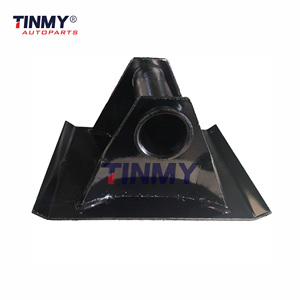

Explore heavy-duty support legs engineered for standard freight, drop-deck haulers, and severe-duty side-dump trailers. Every assembly features cold-formed steel casing, precision planetary gears, and universal foot options.
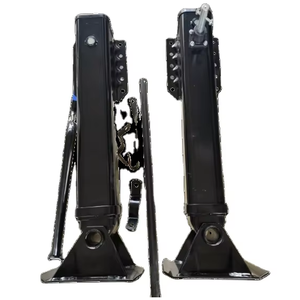
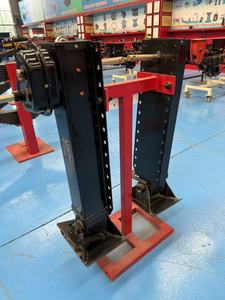
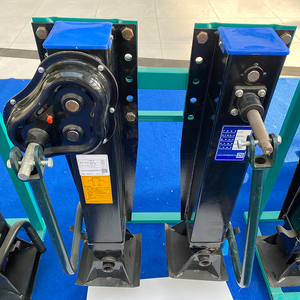
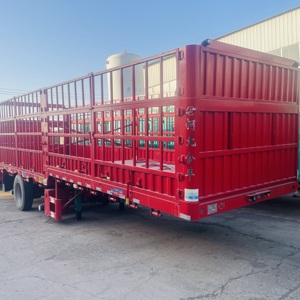
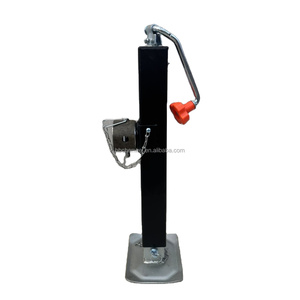
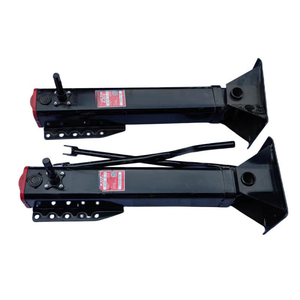
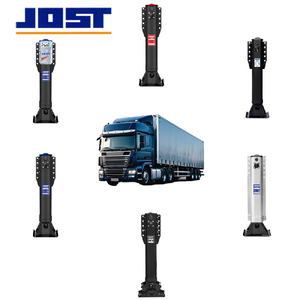
A comprehensive examination of dynamic lifting capacities, axial thrust load distributions, and metallurgy requirements for fleet engineers.
In intermodal transport and cross-border commercial fleet logistics, the semi-trailer landing gear represents a mission-critical structural interface. When a prime mover uncouples from a fully freighted semi-trailer, the entire front cantilevered mass transfers instantaneously from the fifth-wheel tractor plate to the landing gear pair. Commercial procurement officers often make the costly oversight of conflating Static Test Load ratings with Dynamic Lifting Capacity.
Dynamic lifting capacity dictates the maximum vertical weight the internal bevel drive and screw mechanism can safely elevate under standard operational hand-crank torque (approximately 250 to 320 Nm applied force). Conversely, the static load rating determines structural buckling limits against vertical and lateral shear forces when the uncoupled trailer sits stationary at loading docks or undergoes high-frequency forklift transit maneuvers.
Modern commercial landing gear assemblies employ high-tensile, low-alloy (HSLA) Q345B steel for outer housings, matched with induction-hardened, rolled-thread lead screws. Cold-drawn tubing minimizes wall-thickness variances while offering up to 20% weight reduction over traditional cast housings. Below is an engineering reference matrix illustrating critical physical parameters across standard international fleet configurations:
| Nominal Rating | Dynamic Lift Capacity | Static Proof Load | High Gear Ratio / Stroke | Low Gear Ratio / Stroke | Foot Type Suitability |
|---|---|---|---|---|---|
| Light Utility (7,000 lbs) | 3.2 Metric Tons | 5.5 Metric Tons | Direct Crank (3.8 mm/turn) | N/A (Single Speed) | Swivel Foot / Removable Pin |
| Standard Haul (28 Ton Class) | 28.0 Metric Tons | 50.0 Metric Tons | 7.2 mm / Crank Turn | 0.9 mm / Crank Turn | T-Shoe / S-Foot (Cushion) |
| Severe Duty (32-35 Ton Class) | 32.0 Metric Tons | 60.0 Metric Tons | 6.8 mm / Crank Turn | 0.7 mm / Crank Turn | G-Foot (Heavy Rocker Base) |
| Heavy Multimodal (60-80 Ton Class) | 38.0 Metric Tons | 80.0 Metric Tons | 5.4 mm / Crank Turn | 0.5 mm / Crank Turn | Reinforced Broad Skid Plate |
Gearbox design directly dictates operational ergonomic safety. Modern double-speed reduction gearboxes integrate self-locking spiral bevel gears that inhibit free-fall slippage under eccentric load transfers. The high-gear setting allows swift ground approach (averaging 6 to 8 crank turns per inch of drop), while the low-gear multiplier distributes high hydraulic-equivalent lifting mechanical advantage, allowing solo operators to level heavily burdened tri-axle chassis without ergonomic strain injuries.
Strategic purchasing managers are navigating evolving emission mandates, chassis lightweighting, and automated logistics yards. These three pillars define future supply contracts.
Electric and autonomous terminal tractors demand push-button, solar-supplemented, or pneumatic 24V electro-hydraulic landing legs. Bypassing manual cranking eliminates driver fatigue and drastically reduces terminal turn-around cycles.
With aggressive European and North American axle weight regulations, fleet owners prioritize ultra-high-strength steel jackets coupled with forged aluminum lower extensions, slashing up to 40 kg per assembly pair without load-bearing sacrifice.
Chemical de-icers on highways degrade standard electro-zinc coatings rapidly. Exporters are shifting to hot-dip zinc-nickel alloy immersion and cataphoresis primer baking, ensuring zero red-rust penetration through 1,500+ salt-spray test hours.
Understanding factory tooling and metallurgic advancements enables procurement agents to distinguish tier-one manufacturing from substandard fabrication.
Traditional machined screws introduce micro-groove stress concentrations. Advanced production replaces machining with CNC cold-thread rolling, preserving continuous metal grain lines and raising thread shear strength by over 35%.
Standard mineral greases stiffen in sub-zero Nordic or Canadian conditions. Factories now pack internal gear trains with aerospace-grade synthetic lithium-complex grease rated down to -45°C, ensuring buttery smooth gear transitions all season.
Modern production tooling conforms strictly to international 10-hole and 8-hole side-mounting plates. This universal hole pitch permits interchangeability across JOST, Fuwa, Holland, and SAF-Holland mount footprints without chassis re-drilling.
Combining industrial automotive manufacturing roots with full documentation transparency, we eliminate the risks associated with wrong-fit deliveries and long-distance freight delays.
Positioned right within Türkiye's core automotive corridor, securing direct manufacturer pipelines, accelerated quality audits, and reduced overland port transit to Gemlik and Istanbul terminals.
Every part number is mapped against extensive technical datasets: casing wall thickness, stroke distance, bevel backlash, and flange specs. We guarantee 100% fitting accuracy prior to container loading.
Seamless execution of commercial invoices, packing lists, Mill Test Certificates (MTC), Certificates of Origin, and A.TR or EUR.1 certificates to leverage preferential tariff access under trade union conventions.
Founder-led coordination across English, Turkish, German, and French. Direct accountability means zero lost information between workshop blueprints, production floors, and shipping manifests.
Clear, definitive answers to technical queries, ordering protocols, interchangeability, and logistical terms for commercial vehicle buyers.
Send your OEM part numbers, technical drawings, or target fleet specifications to our Bursa export team. Receive immediate cross-reference validation, pricing schedules, and shipment timetables.