
Precision Chassis & Drivetrain Assemblies
Export Portfolio: ECAS Height Sensors & Fleet Systems
Direct export configurations cross-matched against European OEM parts catalogues. Every component is subjected to strict bench tests before containerization in Bursa, Türkiye.
±1 mm
Chassis Dynamic Tolerance
Crit’Air & Intermodal Freight Corridors
Across French metropolitan transport axes (A1 corridor Lille-Paris, A6/A7 Paris-Lyon-Marseille), Electronically Controlled Air Suspension (ECAS) height sensors maintain aerodynamic efficiency, mitigating chassis drag by stabilizing cruise height at exact millimeter tolerances to meet strict national CO2 reduction guidelines.
IP69K
Hermetic Ingress Protection
Saline & Winter Alpine Resistance
Winter freight transit through the Rhône-Alpes and cross-border passes via the Mont Blanc Tunnel demands harsh environmental isolation. Export-grade sensors feature high-density thermoplastic housings with fluorine rubber elastomer seals to neutralize calcium chloride road-salt corrosion.
100%
EU Customs Union Ready
Seamless EU–Türkiye A.TR Documentation
Export operations routed through Nilüfer, Bursa bypass external tariff bottlenecks via bilateral Customs Union protocols. French fleet purchasers, wholesale distributors, and bodywork constructors leverage rapid A.TR movement certifications for streamlined, duty-free clearance.
Engineering Whitepaper: ECAS Sensor Physics & Dynamic Damping Architectures
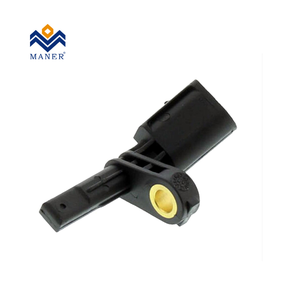
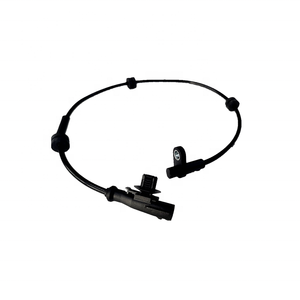
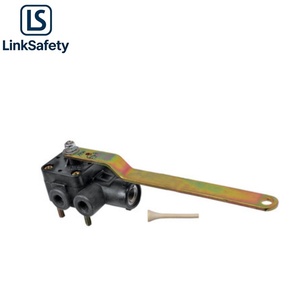
Electronically Controlled Air Suspension (ECAS) represents the critical sensory feedback interface in modern commercial automotive chassis architectures. Unlike legacy mechanical leveling valves—which utilize mechanical linkage arms to continuously charge or exhaust air spring bellows during every minor chassis displacement—an ECAS architecture uncouples instantaneous dynamic road chatter from pneumatic actuator cycles. By integrating non-contact Hall-effect angular displacement transducers, the vehicle ECU dynamically filters low-amplitude axle oscillations, actuating pneumatic solenoid valves only when persistent mass variations or payload imbalances are detected.
For fleet maintenance engineers, wholesale replacement part importers, and trailer manufacturers (carrossiers industriels) across France, maintaining strict measurement accuracy at the axle interface directly impacts braking modulation, electronic stability control (ESC) performance, and directional tire tread longevity. A variance of as little as 3.5 degrees in linkage arm zero-offset calibration can skew automated headlight leveling, destabilize unladen axle weight transfer ratios during emergency regenerative braking, and trigger unexpected CAN-bus diagnostic fault codes (DTCs) in modern EBS/ESP multiplex networks.
Comparative Architecture: Hall Effect Non-Contact vs. Potentiometric Sensors
The operational lifecycle of suspension sensors deployed across French national routes (autoroutes and departmental roads alike) is dictated by their internal signal generation topology. Below is an engineering evaluation comparing traditional resistive contact tracks against contact-free inductive/Hall-effect sensing arrays utilized in KNB Automotive export consignments:
| Functional Parameter | Conventional Potentiometric Sensor | Solid-State Contactless Hall-Effect Sensor | Fleet Economic Impact |
|---|---|---|---|
| Mechanical Wear Lifecycle | Resistive substrate degrades after ~2.5M cycles (wiper erosion). | Virtually limitless rotational lifecycle (>15M cycles); zero physical contact. | Prevents premature fleet breakdown and roadside inspections by French DREAL officials. |
| Output Signal Integrity | Susceptible to noise spikes from internal carbon track micro-pitting. | Clean PWM or ratiometric analog voltage curve; high signal-to-noise ratio. | Eliminates erratic solenoid valve bouncing, preserving air compressor duty cycle. |
| Thermal Coefficient | Resistance value drifts >6% over -30°C to +85°C swings. | Integrated internal thermal compensation (<0.8% drift across full range). | Maintains precise deck height consistency during transit across changing altitudes. |
| Chemical & Salt Resistance | Moisture seepage across seal leads to wiper oxidation. | Internal electronic circuitry fully encapsulated in vacuum-injected epoxy resin. | Survives de-icing chemicals and high-pressure steam cleaning in maintenance bays. |
Localized French Operational Environment & Application Scenarios
French road freight dynamics impose specific operational demands on suspension levelling hardware:
1. Ro-Ro Maritime Intermodal Loading (Calais, Dunkerque, Marseille): Trailers embarking on cross-channel ferries or Mediterranean roll-on/roll-off platforms experience severe ramp inclination angles. ECAS height sensors facilitate rapid bellows exhaustion down to minimum bump-stop limits, protecting kingpins and landing gear while avoiding overhead clearance strikes on boarding ramps.
2. Viticulture & Agricultural Seasonal Transport (Bordeaux, Champagne, Languedoc): Harvesting and bulk liquid container transport involve high-center-of-gravity payloads. Tanker slosh dynamic shifts require ECAS height sensors with high sampling frequencies (>100 Hz) to deliver stable height data to roll-stability modules, mitigating rollovers on banked departmental roundabouts.
3. Low-Emission Urban Logistics Zones (ZFE-m): Paris, Lyon, Toulouse, and Marseille strictly limit entry based on vehicle emissions. Perfectly maintained ECAS levelling reduces the aerodynamic coefficient of tractor-trailer combinations by matching cruising chassis rake to optimal wind tunnel parameters, saving up to 1.8% in diesel consumption or conserving traction battery charge on emerging electric tractors like Renault Trucks E-Tech T.
French Truck & Commercial Vehicle Fleet Compatibility
Our Bursa export hub maintains continuous reference cross-indexing for all predominant European truck tractor platforms operating on French motorways:
Renault Trucks: Comprehensive OEM cross-referencing for Renault T-High, T, C, and K series, directly matching reference families such as 74 20 850 557, 74 21 585 711, and 50 10 422 344.
Volvo Trucks: Full coverage for FH12, FH16, FM9, and FM series, matching Volvo group cross-codes 20514066, 20850557, and 85113630.
Mercedes-Benz & MAN: Direct drop-in linkages for Actros (A 000 542 02 18), Atego, TGX, and TGS platforms.
Semi-Trailer Running Gear: Dedicated geometric linkage geometries compatible with SAF-HOLLAND, BPW, Schmitz Cargobull, and Krone running gear suspensions.
Bursa Export Hub Infrastructure
Why Global Fleet Importers Choose Our Export Operations
Positioned in Bursa, Türkiye's primary automotive and precision manufacturing industrial region, KNB Automotive bridges high-precision manufacturing ecosystems directly with international enterprise supply chains.
Bursa Supplier Base
Direct access to major commercial vehicle component and mould engineering clusters, cutting production lead times to European distribution hubs.
OEM Cross-Reference Engine
Standardized KNB cataloging maps OEM numbers, aftermarket equivalents, electrical connector styles, and linkage geometries to eliminate incorrect orders.
Multilingual Export Desk
Direct technical communication in French, English, German, and Turkish. Commercial contracts and technical briefs handled without language gaps.
A.TR & EU Trade Clearance
Preferential customs status under the EU–Türkiye customs agreement provides duty-free entry into French ports and road hubs with complete customs documentation.
Buyer Advisory
Frequently Asked Procurement Inquiries (France & EU)
Key technical, regulatory, and logistics details for procurement managers and spare parts distributors across France.
What documentation accompanies ECAS height sensor export shipments to France? +
Every commercial consignment from our Bursa export facility includes an international Commercial Invoice, a detailed Packing List specifying Net/Gross mass and individual HS Codes (typically 9031.80 or 8708.29), and a Certificate of Origin. Crucially for buyers in France, an A.TR Movement Certificate is supplied for industrial goods manufactured within Türkiye, qualifying the shipment for preferential zero-customs-tariff treatment upon entry into French customs borders.
How do you guarantee sensor compatibility with Renault Trucks and French trailer builders?
+
We verify each order against factory OEM part numbers, vehicle VIN groups, sensor stroke angles, and pinout electrical topologies (including standard 3-pin and 4-pin DIN Bayonet, M12, or Packard connectors). Whether outfitting a Renault T480 fleet or supplying trailer builders using SAF, BPW, or JOST axles, cross-references are confirmed by our technical team before warehouse dispatch.
Can French clients order mixed part groups in a consolidated shipment? +
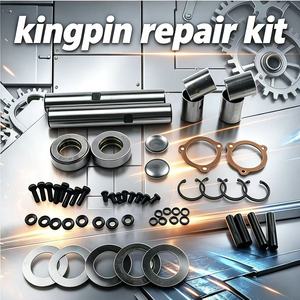
Yes. Our Bursa operations regularly consolidate mixed chassis and pneumatic components into unified containerized or palletized freight. You can combine ECAS height sensors, mechanical leveling valves, brake chambers, slack adjusters, wheel hubs, and kingpin repair kits into one consolidated export packing list, lowering overall LTL/FTL transport overheads.
What are the lead times for delivery to French logistic hubs (Paris, Lyon, Marseille)? +
Road freight transit from Bursa across the Southeastern European corridor to distribution centers in Paris (Île-de-France), Lyon, or Lille typically takes 5 to 7 business days following customs dispatch. Intermodal maritime routes connecting Turkish ports directly to Toulon or Marseille offer cost-effective options for bulk recurring container shipments.
What minimum order quantities (MOQ) apply for aftermarket distributors? +
There is no single rigid MOQ across our catalog. Minimum quantities are evaluated based on batch packaging, private labeling requests, and stock availability. Contact our export desk with your planned schedule, and we will tailor an efficient commercial order breakdown.
Are sensors calibrated to withstand high salt and freeze-thaw cycles? +
Yes. Height sensors intended for European distribution are built to IP67 and IP69K sealing standards. The composite polymer housings undergo cyclic salt-spray tests and thermal shock resistance cycles (-40°C to +125°C), ensuring long-term reliability in harsh winter environments like the French Alps and Massif Central.